- Artificial Intelligence
UK vs EU AI regulation: what businesses need to know in 2026
Artificial intelligence is advancing at an extremely rapid pace, with new systems often appearing before lawmakers have agreed on how they should be governed. As a result, regulators are under pressure to respond without slowing progress or ignoring real risks.
In the European Union, this has led to the adoption of a standalone legal framework aimed specifically at AI. The UK’s approach to regulating the use of AI is different – it relies on existing regulators and guidelines. While both approaches share a common aim of ensuring trustworthy development and use of AI, the differences matter for businesses operating across borders, forcing them to navigate overlapping expectations.
Our article explores AI laws and regulations in the EU and the UK, focusing on what they mean in practice for companies using AI.
The EU AI Act – a compliance game-changer
The EU AI Act entered into force in August 2024. For the first time, AI stopped being regulated indirectly through data protection or sector-specific rules. It became a subject of regulation in its own right, with direct obligations for businesses that build or rely on AI systems.
The first global AI law
The EU’s AI Act is the world’s first attempt to regulate artificial intelligence in a comprehensive and systematic way. Instead of focusing on a single technology or industry, it sets out rules that apply across sectors and use cases.
The Act aims to make AI systems safer and more transparent, while still fostering innovation. The idea is to ensure that systems that can affect people’s rights are designed and used responsibly.
Importantly, the EU AI Act’s reach goes beyond EU borders. Any AI systems used within the EU must comply, no matter where the company is based. In practice, this means that many global businesses need to align their AI practices with EU standards.
The risk-based approach
The EU AI Act classifies AI systems based on the level of risk they pose:
- Unacceptable risk. This category includes systems designed for social scoring or for manipulating individuals in ways that cause harm. Such systems are prohibited in the EU.
- High risk. AI used in sensitive areas such as creditworthiness assessments, recruitment, medical devices, or access to essential services faces the strictest obligations. These systems are allowed, but only if they meet detailed compliance requirements.
- Limited risk. Some applications are subject mainly to transparency rules. A common example is chatbots, which must clearly state that users are interacting with an AI system.
- Minimal risk. Most everyday AI tools fall into this category. They can be developed and used freely, with little regulatory oversight.
This classification matters because leadership teams need a clear view of how AI is used across the organisation. Without that visibility, it is easy to overlook use cases that qualify as high risk.
What businesses must do
The EU AI Act introduces obligations that are, in fact, familiar to organisations that have already worked through GDPR. According to the EU AI Act, companies have to:
1. Establish formal AI governance
Companies must define who is responsible for AI oversight. This typically involves assigning ownership at the management level and integrating AI controls into existing compliance structures.
2. Maintain detailed technical and operational documentation
Organisations are required to keep records that explain how an AI system works. This includes information about training data, system capabilities and limitations, performance metrics, and the role of human supervision.
3. Carry out risk assessments before deployment
According to the Act, high-risk AI systems can’t be rolled out without prior internal evaluation. Companies must assess foreseeable risks to individuals’ rights, safety, and well-being, as well as demonstrate that appropriate safeguards are in place.
4. Ensure human oversight is meaningful
The Act requires that the staff must be able to understand system outputs, intervene when needed, and override automated decisions where appropriate.
5. Monitor systems after launch
Organisations must continuously track performance, identify risks, and address incidents or malfunctions without delay.
6. Report serious incidents and malfunctions
Certain failures must be reported to regulators, especially where they affect health, safety, or fundamental rights.
Failure to meet the EU’s requirements can trigger fines of up to €35 million or 7% of global annual turnover.
The UK’s flexible, pro-innovation approach
The UK government has taken a different, pro-innovation approach to AI regulation. Instead of introducing standalone AI legislation, it adapts existing laws to cover AI-related risks. As a result, the UK’s AI regulatory framework leaves more room for interpretation and more responsibility with the companies using AI technologies.
Principles over prescriptions
The UK approach is built around a set of principles:
1. Safety, security, robustness
AI systems should function as intended, remain resilient to misuse, and avoid causing harm.
2. Transparency and explainability
Organisations should be able to explain how their AI systems work, at a level that is appropriate to the context and the impact of the decision being made.
3. Fairness
The use of AI should not lead to unjustified discrimination or biased outcomes, particularly where decisions affect access to services, employment, or financial products.
4. Accountability and governance
Someone within the organisation must be answerable for how AI systems are designed, deployed, and controlled.
5. Contestability and redress
People affected by AI-driven decisions should have a way to challenge outcomes and seek correction or remedy where things go wrong.
Depending on the sector, each regulator (FCA, ICO, CMA, MHRA, etc.) applies these principles within its own domain.
Current direction in UK AI regulation
From the perspective of AI regulation, UK regulators have focused on practical initiatives, which exist alongside the principles-based approach and are meant to address specific risks without changing the overall framework.
One of the steps is the work of the AI Safety Institute. It has started testing large AI models to understand where risks and bias may arise. Its aim is to identify issues early, particularly in systems that operate at scale or influence important decisions.
The UK has also kept up its involvement in international coordination. It played a central role in the Bletchley Declaration and continues to engage through forums such as the G7 Code of Conduct.
What this means for businesses
The absence of a single UK AI regulation doesn’t mean the absence of regulatory expectations. The rules are less explicit, but they still exist, and they are enforced through existing legal and supervisory channels.
There is more freedom in how organisations approach AI governance, but it comes with greater responsibility at the senior level. Boards and executive teams need to understand how AI is used across the business, rather than treating it as a purely technical matter.
Businesses are also expected to show that they are managing AI-related risks in a deliberate way. This includes identifying where systems may affect individuals, documenting design choices, and putting controls in place.
Finally, operating from the UK doesn’t protect companies from obligations elsewhere. Where AI systems are used in the EU market, EU-level requirements will still apply to UK businesses, even if the system was deployed from the UK.
AI regulation: EU vs UK
While the EU and the UK share an aim of ensuring responsible development and use of artificial intelligence, they have taken noticeably different paths to regulating AI. The comparison below highlights how these regulatory approaches differ.
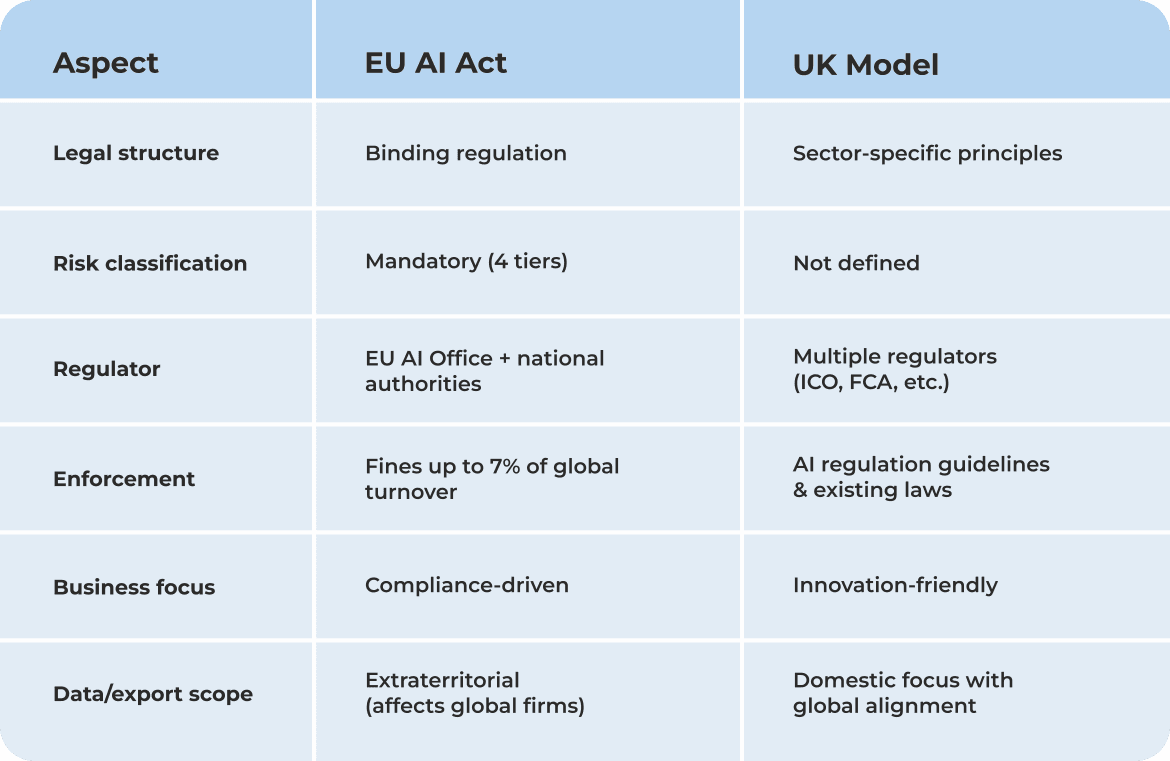
If your business operates in both markets, you need to meet EU AI regulations while working within the UK’s principles-based model.
Business implications
Strategic planning
AI oversight has moved beyond legal compliance into core business decision-making. Choices about where to invest, which partners to work with, and how products are designed increasingly depend on how AI risks are understood and managed.
For leadership teams, this means that AI governance should be treated in the same way as cybersecurity or data protection, embedded into existing risk frameworks and discussed at the board level, not only when issues arise.
Operational readiness
Most organisations already use AI in day-to-day operations, often across multiple functions, including human resources, finance, customer support, analytics, and marketing.
Businesses need a clear picture of where AI is in use and which applications may fall into higher-risk categories under EU rules. Otherwise, it becomes difficult to manage AI deployments in a controlled and predictable way.
Companies need to take care of the documentation and accountability early to avoid disruption later. Leaving this work until formal enforcement or external scrutiny begins can slow projects.
Reputational considerations
How a company uses AI is visible to customers, partners, and regulators.
Companies that can demonstrate responsible AI practices tend to face fewer questions during audits, partnership discussions, and investment rounds. In regulated sectors in particular, evidence of AI oversight is becoming a standard part of due diligence.
Cross-border challenges
Again, UK-based companies serving EU clients are expected to meet EU requirements, regardless of where their systems are developed or managed. The same applies in reverse: EU organisations relying on UK vendors must ensure those partners meet applicable compliance expectations.
How leaders can act now
While regulatory frameworks continue to evolve, there are practical steps leaders can take now to reduce risk and improve oversight.
1. Audit AI use across the organisation
It’s important to map where AI is already in use in the company, paying particular attention to systems that influence decisions.
2. Assign clear ownership for AI compliance
Someone needs to be responsible for how AI is governed in practice. In many organisations, this role naturally fits in data protection, risk, or innovation teams.
3. Put an internal AI policy in place
A policy should outline how data can be used, how bias is assessed, and what level of explainability is expected from models used in different contexts.
4. Make AI part of internal training
Employees need to know when AI is involved and what it means for their work. Basic awareness reduces misuse and helps spot issues early.
5. Track regulatory and policy signals
The landscape is still evolving. By regularly following updates from the relevant regulatory bodies, companies can avoid surprises and plan more effectively.
6. Set expectations with partners and vendors
Many AI risks originate outside the organisation’s systems. When working with third parties, transparency around models, data sources, and controls should be a standard requirement.
Key 2025 UK and EU AI regulations takeaways
While EU and UK approaches towards AI differ, their underlying aim is largely the same. Both are trying to ensure that AI systems are used in a responsible, transparent way.
For businesses, AI governance is no longer a secondary issue. It shapes how products are built, who companies work with, and how decisions are explained when challenged. Companies that have already started treating AI governance as part of their day-to-day operations are better prepared to adapt as regulations tighten.
FAQs about UK and EU AI regulation
What is the main difference between UK and EU AI regulation?
There is a single, binding EU AI regulation that sets out clear legal obligations based on the risk level of an AI system. The UK, on the other hand, relies on existing regulators and a set of guiding principles. In practice, this means EU compliance is more prescriptive, while the UK approach leaves more room for interpretation.
Do UK companies need to comply with the EU AI Act?
If an AI system is used in the EU, the EU AI Act applies regardless of where the company is headquartered. As a result, a UK company that develops, deploys, or supplies AI systems in the EU must comply.
What are the penalties for non-compliance with the EU AI Act?
Depending on the infringement, penalties can reach up to €35 million or up to 7% of a company’s global annual turnover.
When does the EU AI Act fully come into effect?
While the Act entered into force in August 2024, its obligations are being applied in stages. Some provisions, including bans on certain uses, already apply. Other requirements, particularly those affecting high-risk AI systems, are scheduled to apply later. Full application is expected during 2026.
Can I be fined for AI non-compliance in the UK?
While there is no standalone law governing the use of AI in the UK, companies can face enforcement action under existing laws governing data protection, equality, consumer protection, competition, and others.

Thanks for reading!
DeepInspire / boutique software development company