- Fintech
How do you build real-time business intelligence software for a scaling fintech?

Fintech companies quickly outgrow simple reporting as transaction volumes and data sources increase. They need a faster, more reliable way to turn that data into information they can use for everyday decisions.
Real-time business intelligence helps bring this data together and turn it into a clear view of what is happening across the business. In this article, we take a detailed look at business intelligence in fintech, how it works, where it adds the most value and what it takes to build a system that can scale with the company.
Summary: business intelligence for fintech companies
The role of business intelligence in financial services is increasingly important. It helps companies bring together data from payment systems, CRM platforms, product tools and financial software so teams can track performance in one place. They can monitor key metrics, investigate problems and make better decisions based on real-time insights.
A well-designed system can improve visibility across payments, revenue, customer activity, lending, risk and operations, but the most effective solutions are built around clear business use cases.
How does business intelligence work in fintech?
In fintech, business intelligence brings data from payment systems, CRM platforms, product applications and financial tools into a shared analytics environment. The data is collected through APIs, data pipelines or streaming infrastructure, then cleaned, matched and prepared for analysis.
Once processed, the data feeds a metrics layer where business definitions and calculations are applied. This is where raw data is used to calculate useful metrics such as payment success rate, transaction volume, revenue, customer activity and fraud indicators.
These metrics can then appear in reports, real-time dashboards and alerts. Teams use them to spot changes, investigate problems and make decisions based on real-time data rather than information spread across separate systems.
Why do scaling fintech companies need real-time BI software?
As a fintech grows, the amount of data it generates increases quickly. Higher transaction volumes create more data points, while new payment providers, CRM systems and product tools add more data sources. Different teams may also start using their own reports and definitions for the same metrics.
Without a shared, real-time BI system, this can lead to data silos and reporting delays. A shared BI system gives growing fintech companies a more consistent view of performance, while real-time processing reduces the delay between an event occurring and appearing in dashboards or reports.
Fresh data can be processed as it is generated and presented through dashboards and alerts, making it easier to monitor transactions, customer activity and other important business metrics as the company scales.
Key use cases for business intelligence in fintech
Business intelligence can effectively support both day-to-day monitoring and longer-term planning. While the exact use cases depend on the product, most fintech companies need to understand customer behaviour, payment performance, financial risk and the movement of money across their systems.
Customer, product and revenue analytics
BI software can combine customer, product and revenue data to identify usage patterns and areas where the business is growing. Teams can analyse acquisition, activation, retention and revenue by customer segment, product or market, helping them understand which areas contribute most to business goals.
Payment performance and revenue leakage monitoring
For payment businesses, even small issues can have a measurable financial impact at scale. Real-time analytics can track approval and decline rates, processing fees, failed payments and other transaction metrics. This allows teams to identify problems with a particular payment provider, market or transaction type and investigate potential revenue leakage earlier.
Fraud, risk and compliance analytics
Fintech companies can use data analytics to monitor unusual transaction patterns, account activity, failed authentication attempts and changes in customer behaviour. Real-time alerts can bring suspicious behaviour to the attention of fraud or compliance teams, while historical data can help them identify recurring patterns and improve risk models.
Cash flow, settlement and reconciliation analytics
BI software can provide a clear view of money moving between customers, payment processors, banks and internal accounts. Finance and operations teams can monitor settlements, reconciliation differences and cash positions without relying on separate spreadsheets or delayed reports.
Lending and credit risk analytics
In lending, BI can be used to monitor application volumes, approval rates, repayment behaviour, arrears and portfolio performance. Predictive analytics can draw on historical and current data to support credit risk assessment and help teams spot changes in borrower behaviour.
Embedded analytics for fintech customers
Fintech companies can embed dashboards and reporting features directly into their products, allowing customers to access data and insights. Depending on the product, this might include transaction reports, spending patterns, portfolio performance or payment analytics.
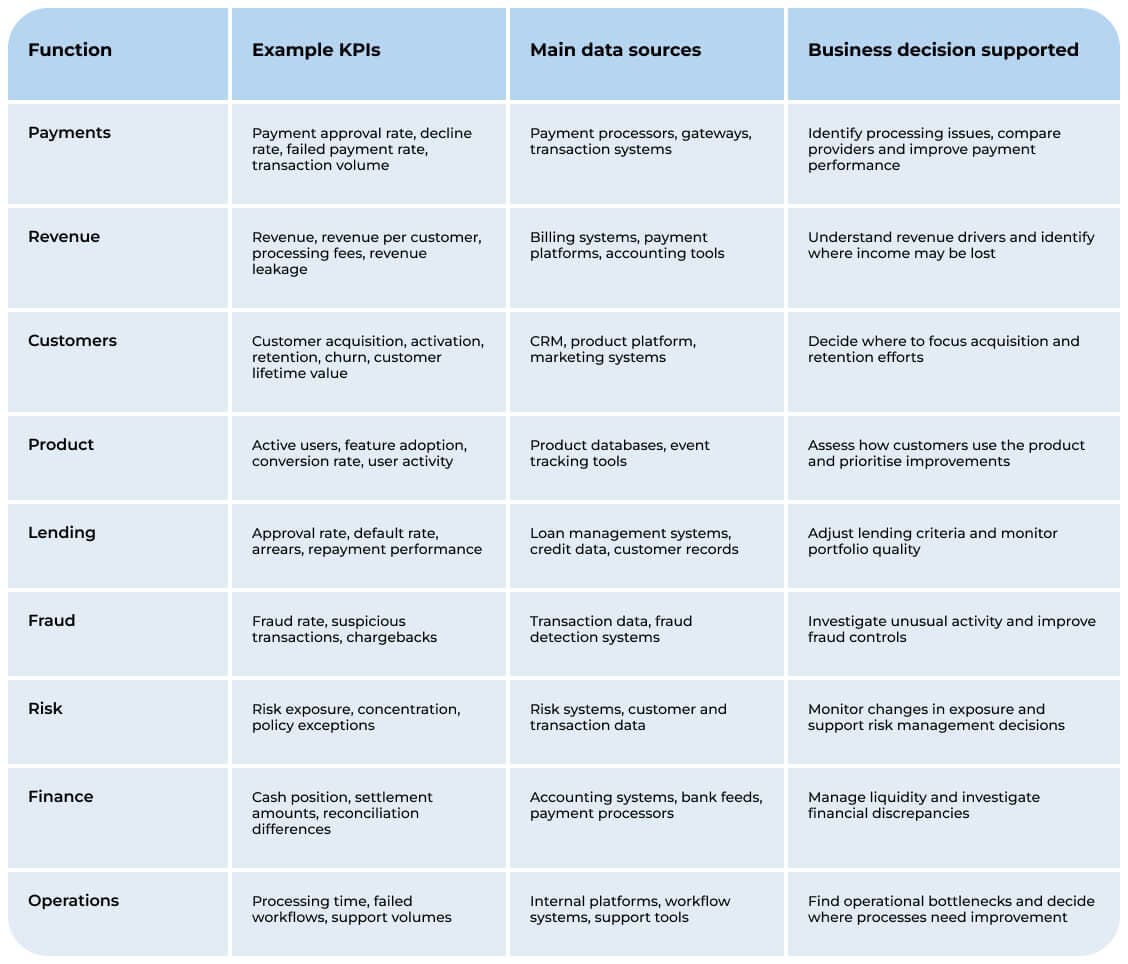
Which KPIs should a fintech BI system track?
KPIs help fintech teams turn vast amounts of data into a clear view of business performance. Tracking the right metrics makes it easier to spot problems, measure progress and make informed decisions.
The right KPIs depend on the fintech product and its business goals. A BI system should connect each metric to a reliable data source and, more importantly, to a decision that someone in the business needs to make.
What business results can real-time BI software deliver for fintech?
The main benefit of real-time BI is not simply having fresher data. It is being able to act on changes while they still matter. When teams can see current performance without waiting for reports, they can make decisions sooner and respond to problems before their impact grows.
For a fintech company, this can mean identifying failed payments or revenue leakage earlier, detecting changes in customer behaviour and reacting faster to operational or risk issues. Real-time insights also reduce the time teams spend collecting data manually or reconciling figures from separate systems.
As the business scales, a shared view of current data helps different teams work from the same information, supporting more efficient business operations and better customer experience.
How to build real-time business intelligence software for fintech
A successful fintech BI implementation starts with business needs, not technology. The system should be designed around the decisions teams need to make, the data required to support them and how quickly that data needs to become available.
Define BI use cases and business decisions
Start with a discovery phase where you identify the problems the BI system should solve, the users it needs to support and the business decisions it should inform. This could include monitoring payment performance, tracking customer behaviour, managing credit risk or giving clients access to embedded analytics. Each use case should be linked to a clear business decision.
Map fintech data sources and integration requirements
Next, identify where the required data comes from. A fintech platform may need to combine data from payment processors, CRM systems, banking APIs, accounting tools and internal product databases. At this stage, teams should also define how data from different sources will be connected and matched.
Define KPIs, data ownership and latency requirements
Agree on how important metrics are calculated and who owns each data set. It is also important to decide how fresh the data needs to be. Fraud monitoring may require data in near real time, while some finance or management reports can tolerate longer delays.
Design the data ingestion and processing layer
The next step is to build the flow of data into the BI platform. Depending on the use case, this may involve APIs, change data capture, batch pipelines or real-time data streaming. The architecture should support reliable data ingestion as transaction volumes increase.
Choose analytical storage
Processed data needs a suitable place for analysis. This may be a cloud data warehouse, data lakehouse or another analytical database, depending on data volumes, query patterns and performance requirements.
Build a trusted metrics and semantic layer
A shared metrics layer helps ensure that teams use the same definitions for revenue, active customers, payment success rates and other KPIs. This reduces conflicting reports and improves data quality and consistency across the business.
Develop role-based dashboards and embedded analytics
Dashboards should reflect how different teams use data. Finance, product, risk and operations teams are unlikely to need the same view. Where analytics are part of the fintech product itself, dashboards and reports can also be embedded directly into the customer interface.
Configure real-time alerts and anomaly detection
Real-time alerts notify teams when important metrics move outside expected ranges, while anomaly detection can help identify unusual transaction patterns or other issues that need investigation.
Test data accuracy, security and performance
Before launch, verify that access controls work as intended and the platform performs reliably under expected data loads. Testing should also confirm that data from multiple sources remains consistent as it moves through the system.
Launch iteratively and monitor adoption
It is usually more effective to start with the highest-priority decisions, gather feedback and expand from there. After launch, monitor which dashboards and metrics teams actually use so the system continues to support real business needs.
Security and data governance for UK fintech BI software
Fintech BI systems can contain transaction records, customer information and other sensitive financial data, so security and data governance need to be designed into the platform from the start.
- Role-based access limits what each user can view or change, while encryption protects relevant data in storage and during transfer.
- Audit trails provide a record of access and changes made within the system.
- Data lineage helps teams understand where a piece of data came from and how it was transformed before reaching a dashboard.
- Retention rules define how long different data sets are kept.
- Automated validation and monitoring help maintain data quality and consistency across data pipelines.
For UK fintech companies, the design should reflect the regulatory requirements that apply to their business. The UK GDPR requires appropriate measures to protect personal data, including controls over access and security. FCA-regulated firms may also need to consider operational resilience, including their ability to maintain and recover important business services during disruption.
Where a BI platform uses Open Banking data, teams also need to consider secure API access and appropriate controls around customer consent and data sharing. Fintech products that store, process or transmit cardholder data may also fall within PCI DSS requirements covering areas such as access control, encryption and logging.
Modernising legacy fintech BI software
Many fintech companies still rely on legacy BI software that was not designed for today’s data volumes, integration needs or reporting expectations.
That said, legacy BI software does not always need to be replaced in one large project. A gradual approach can reduce risk and allow the existing system to keep supporting the business while new components are introduced.
Modernisation often starts with the parts causing the biggest problems, such as slow data pipelines or outdated dashboards. Teams can then add modern data integration methods, move selected workloads to cloud-based analytical storage and introduce a shared metrics layer without changing everything at once.
Old and new components can run in parallel while data accuracy and performance are checked. Dashboards and reports can then be migrated in stages, starting with the most important use cases. This makes it possible to improve a legacy BI system over time while avoiding the disruption and cost of a complete rebuild.
Common challenges in fintech BI software development
Building BI for financial services is rarely just a matter of connecting a dashboard to a database. Data often comes from multiple systems, uses different formats and may not always be complete or consistent. Bringing these sources together without creating duplicate or conflicting records can take significant work.
Another challenge is balancing speed with reliability. Real-time data processing requires infrastructure that can handle growing transaction volumes without affecting data accuracy or system performance. Metrics also need clear definitions, otherwise different teams may interpret the same business data differently.
Security adds another layer of complexity. Access controls, data retention and regulatory requirements need to be considered throughout development.
Finally, a technically strong BI system is only useful if people actually use it. Dashboards should answer real business questions and present data clearly enough for teams to act on it.
Custom real-time business intelligence software development by DeepInspire
DeepInspire combines extensive fintech experience with expertise in business intelligence, data analytics and custom software development. We design and build BI solutions that bring data from various sources together, support real-time analytics and present relevant metrics through dashboards and reporting tools. We also work with legacy systems, helping companies modernise existing software.
Whether you are looking to build a BI platform from scratch or improve an existing system, DeepInspire can help create a scalable solution tailored to your business needs.
FAQ
Can real-time BI software integrate with multiple payment processors and CRM systems?
Yes. A custom BI platform can connect to multiple payment processors, CRM systems, banking APIs and internal data systems.
Can BI dashboards be embedded into an existing fintech product?
Yes. BI dashboards can be embedded directly into an existing fintech application so customers or internal teams can access analytics without switching to a separate tool. Custom BI dashboard development for fintech can also tailor the interface, metrics and access levels to the needs of the existing product. Access can be controlled by user role, while the dashboard design and data visualisation can be adapted to match the application.
How do you ensure data accuracy in fintech BI software?
Data accuracy starts with clear metric definitions and reliable data sources. Validation rules can check whether incoming data is complete and correctly formatted, while reconciliation processes compare figures between source systems and the BI platform. Automated monitoring can flag unusual changes, helping teams confirm that data is accurate before it is used for decision-making.
How much data latency is acceptable for fintech analytics?
It depends on the use case. Real-time fraud detection or payment monitoring usually require low-latency data ingestion so teams can act within seconds or minutes. Management reporting may work well with near-real-time data ingestion or scheduled updates. The right approach is to define latency requirements for each business process.
Can legacy BI software be modernised without a complete rebuild?
Yes. Legacy BI software can often be modernised gradually by replacing the components that create the biggest limitations first. A company might improve data integration, move selected workloads to modern analytical storage or replace outdated dashboards while keeping other parts of the existing system. This reduces disruption and allows the new and old environments to run in parallel during migration.
Which technologies are used to build real-time fintech BI software?
The technology stack for business intelligence in banking or fintech depends on the amount and variety of data, latency requirements and existing infrastructure. A real-time BI platform may use APIs, change data capture and streaming technologies for data ingestion, together with cloud data warehouses or analytical databases for storage. BI and data visualisation tools are then used to present metrics, while artificial intelligence or data science models can support more advanced analytics.
How long does it take to develop real-time fintech BI software?
The timeline depends on the number of data sources, integration complexity, dashboard requirements and the condition of existing data systems. A focused BI solution with a limited number of integrations can be delivered much faster than a company-wide platform with real-time infrastructure, embedded analytics and complex access controls.

Thanks for reading!
DeepInspire / boutique software development company