- Artificial Intelligence
Why Do AI Projects Fail in Banking? Common Reasons and How to Avoid Them


AI has moved quickly from experimentation to serious investment across banking. However, turning a promising idea into a reliable system is still difficult, with the gap between an impressive demo and a solution that can operate safely often wider than expected.
As a software product development company with years of experience in financial services, we have seen how much depends on the decisions made before and around model development. In this article, we look at where AI projects tend to go wrong in banking and what banks can do to improve their chances of reaching production and delivering real business value.
Summary: why banking AI projects fail
Why do banking AI projects fail? In many cases, the problem is not the AI model itself. Projects struggle when banks start with the technology rather than a clear business need, rely on poor or fragmented data, underestimate integration with legacy systems or fail to plan for production from the beginning.
More problems appear later. Weak ownership can slow decisions, governance requirements may block deployment, costs can rise as the solution scales and employees may not adopt a tool that does not fit their workflow.
What do AI project failure statistics actually show?
Statistics on why AI projects fail vary widely, partly because there is no single definition of failure. An initiative may be considered unsuccessful because a proof of concept is abandoned, the solution never reaches production, costs rise beyond the original budget, expected ROI does not materialise or users simply do not adopt the new system.
This makes headline failure rates difficult to compare. The figures below measure different outcomes at different stages of AI implementation.
S&P Global Market Intelligence, 2025
S&P Global Market Intelligence reported that organisations scrapped an average of **46% of AI projects** between proof of concept and broad adoption. The research covered enterprise AI projects across North America and Europe and treated projects abandoned before production or wider adoption as unsuccessful.
Gartner, 2026
According to Gartner, **at least 50% of generative AI projects had been abandoned after proof of concept by the end of 2025**. The research focused on enterprise generative AI initiatives. Common reasons included poor data quality, inadequate risk controls, rising costs and unclear business value.
Project NANDA, 2025
Project NANDA reported that **95% of organisations studied were seeing no measurable P&L return from their generative AI initiatives**. This preliminary research looked at enterprise GenAI adoption and focused on the absence of measurable financial impact rather than whether the technology itself had been successfully implemented.
SFTI and OST, 2025
Research into the Swiss financial sector found that **17% of AI initiatives had reached deployment and 11% had reached scaling**. However, among the projects that made it into production, **65% met or exceeded expectations**. The findings suggest that a major challenge lies in moving AI initiatives beyond early experimentation and into production and wider use.
The figures point to a more useful conclusion than any single percentage: much of the difficulty comes when organisations try to move from experimentation to operational use. S&P Global found that almost half of projects were dropped somewhere between proof of concept and broad adoption, while Gartner identified a similar problem specifically with generative AI.
The financial-services data adds an important perspective. The Swiss study found that relatively few initiatives had reached deployment or scaling, yet 65% of those that made it into production met or exceeded their business-case expectations. This suggests that the challenge is not simply whether AI models work. For banks, getting a promising idea through integration, governance and production requirements can be the harder part.
A technically sound model can therefore still belong to a failed project. In banking, the real challenge is often what happens around the model rather than the model itself.
Why are AI projects especially difficult in banking?
Banks face many of the same AI implementation challenges as other businesses, but the consequences of getting things wrong can be much greater. AI may be used in processes that affect lending decisions, fraud detection, payments or customer service, where inaccurate or inconsistent output can create financial, regulatory or reputational risk.
The technology has to fit strict security, compliance and model risk requirements. Banks may need to explain how a decision was made, keep records for audit purposes and demonstrate that appropriate controls are in place.
Moreover, many banks still depend on legacy systems, while data may be fragmented across different platforms. Connecting AI models to scattered data sources without disrupting critical operations can require significant integration work.
Finally, AI projects rarely belong to one team. Business leaders, technology teams, risk specialists, compliance functions and end users may all need to be involved in decisions about how the system is designed and used. This makes alignment harder and can slow down implementation.
Common reasons why AI projects fail in banking
So, why do AI projects fail? The reasons are rarely limited to the model itself. In banking, projects often run into trouble because the original use case is weak, the data is not ready, integration proves harder than expected or the organisation has no clear path from an AI pilot to day-to-day use.
Below, we take a detailed look at the most common reasons why AI projects fail.
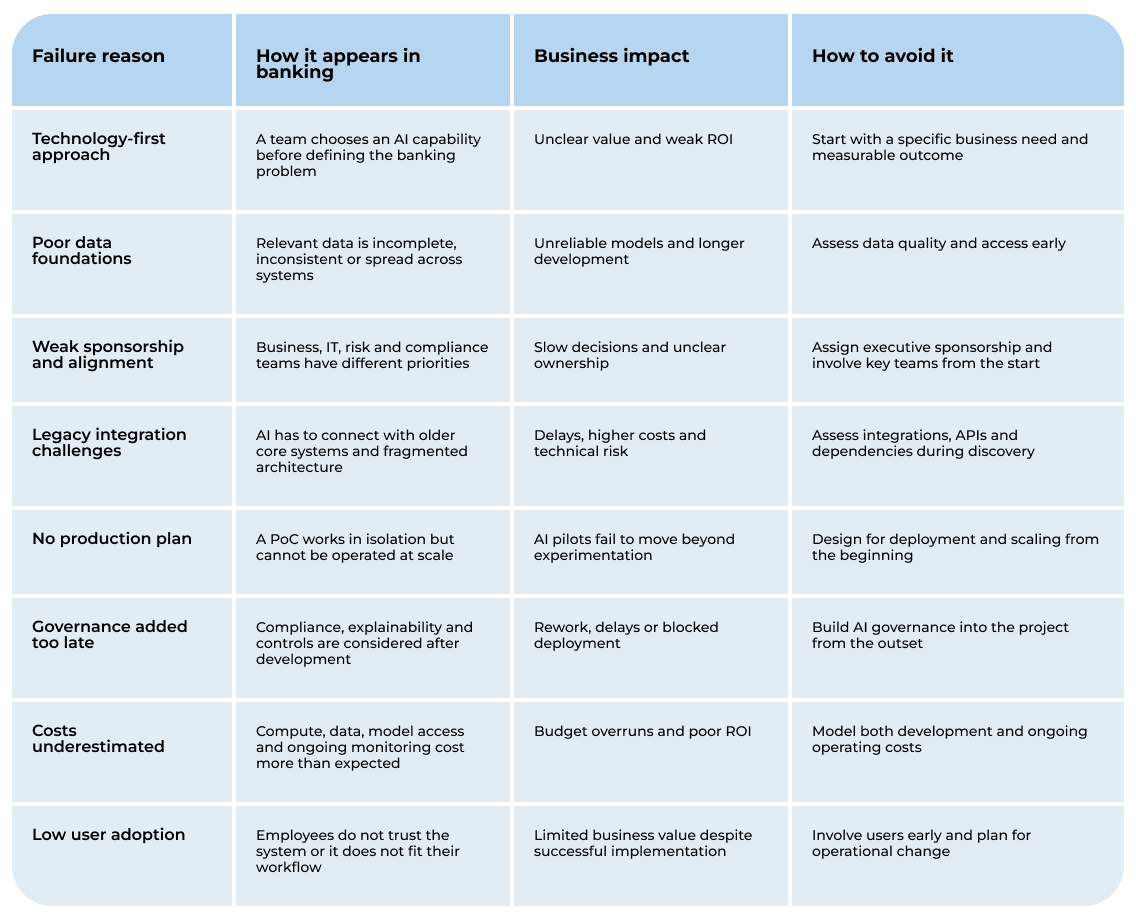
1. Starting with AI technology instead of a banking problem
Interest in AI can create pressure to launch projects simply because the technology appears promising. As a result, a bank can end up building a technically impressive solution without a strong reason to use it.
A better starting point is a defined banking problem. The team should understand how the process works today and what improvement would make the project worthwhile. A fraud detection model, for example, needs a clearer objective than simply “use machine learning for fraud”. The goal might instead be to reduce false positives or identify suspicious transactions earlier.
2. Poor data quality and fragmented data foundations
AI models depend on the information available to them. In banking, data is scattered across core systems, CRM platforms, payment infrastructure and older databases. Different data sources may use inconsistent formats or contain gaps that were manageable for existing processes but become a serious problem when the information is used for AI.
Poor data quality can weaken model performance and add months of preparation before development can progress. It can also make outputs difficult to trust.
Banks need to understand what data is required, where it is stored and whether it can be accessed and used for the intended purpose.
3. Lack of executive sponsorship and cross-functional alignment
Banking AI projects usually cross organisational boundaries. A solution may be commissioned by one business unit but depend on technology teams for integration, risk specialists for model controls and compliance teams for approval.
Problems arise when nobody has enough authority to resolve competing priorities or make decisions when the project reaches a difficult point. Teams may agree that AI is worth exploring while still disagreeing about what success looks like, who owns the risks or which requirements take priority.
Strong executive sponsorship helps remove these blockers, but sponsorship alone is not enough. The people responsible for business outcomes, technology, risk and compliance need to be aligned before major development decisions are made.
4. Underestimating legacy system integration
A model has to connect with the systems around it. This is where apparently straightforward AI projects can become much larger software engineering programmes.
Many banks rely on legacy systems that were never designed to exchange data with modern AI services. APIs may be limited, documentation incomplete or information may need to pass through several existing applications before it reaches the model. Integration also has to respect current security controls and avoid disruption to critical banking operations.
If these dependencies are discovered late, timelines and budgets can change quickly. Reviewing the existing architecture during discovery helps reveal whether the proposed AI solution can realistically fit into it. Experience in digital banking software development can also help teams plan integrations around existing banking systems and infrastructure from the outset.
5. Building a proof of concept without a production plan
A proof of concept is designed to answer the question of whether the idea can work. It does not prove that the same solution can handle real transaction volumes, meet security requirements or operate reliably as part of a banking workflow.
This gap explains why some promising AI pilots never reach production. A prototype may depend on manually prepared data, temporary infrastructure or a model that is too expensive to run at the required scale.
Production requirements should therefore influence technical decisions early. The team needs to consider how the system will be deployed, monitored, integrated and maintained if the PoC succeeds. Planning the AI prototype-to-production transition from the outset can reduce the amount of rework needed later and make it easier to move a successful pilot into real use.
6. Treating compliance and AI governance as an afterthought
Governance can become a major obstacle when it enters the project only after the AI system has already been designed.
Depending on the use case, a bank may need controls around data use, model behaviour, human oversight, explainability and record keeping. Teams also need to know who is responsible for approving changes and what happens when the model produces an incorrect or uncertain output.
Retrofitting these requirements can require substantial rework, so AI governance should shape the design from the beginning.
7. Underestimating AI costs and infrastructure requirements
The cost of an AI project does not end when the model is deployed. Banks may need additional cloud capacity, storage, data pipelines, monitoring tools or paid access to third-party AI models. Usage costs can also increase sharply as the number of users or transactions grows.
A realistic business case should account for ongoing infrastructure, model usage, maintenance and monitoring as well as the initial implementation.
8. Poor change management and low user adoption
Even a reliable AI system delivers little value if employees avoid using it. This often happens when a new tool adds extra steps to an existing process, produces output that users do not trust or changes responsibilities without enough explanation. Teams may continue using familiar methods even after the AI solution has been introduced.
Therefore, user adoption should be considered during product design. Training and clear ownership then become part of implementation, not an afterthought.
How these banking AI failure factors reinforce each other
AI projects rarely fail because of one isolated problem. More often, one weakness creates another and makes the project progressively harder to recover.
An unclear use case, for example, can lead the team to select the wrong data or track metrics that do not reflect real business value. If the project then moves into a proof of concept without considering the bank’s existing architecture, integration problems may appear only when the team tries to deploy it. The additional engineering work extends the timeline and increases costs.
Governance can create another late-stage barrier. A model that performs well in testing may still need significant changes if explainability, audit requirements or data controls were not considered earlier. Even after these issues are resolved, the project may struggle to deliver value if employees do not trust the system or it does not fit naturally into their workflow.
How can banks avoid AI project failure?
An early AI readiness audit can help a bank identify whether the proposed use case, data, technology environment and internal ownership are strong enough to support the project before significant resources are committed.
- Define the business problem before selecting the technology. Start with the banking process or outcome that needs to improve, then decide whether AI is the right approach and how success will be measured.
- Validate data before model development. Confirm that the required data is available, accessible and suitable for the intended use before designing the model around it.
- Create cross-functional ownership. Give the project a clear business owner and involve technology, risk, compliance and other relevant teams early enough to influence important decisions.
- Plan integration and production requirements early. Consider existing systems, APIs, security requirements, expected volumes and monitoring before a proof of concept becomes difficult to adapt.
- Build compliance and governance into the project. Define the necessary controls, approval processes, audit requirements and human oversight as part of the solution design.
- Calculate the full cost of ownership. Look beyond initial development costs to model usage, infrastructure, maintenance, monitoring and future scaling.
- Test the solution in real banking workflows. A model that performs well in isolation may behave differently when connected to existing systems and real users.
- Prepare users and processes for AI adoption. Explain how the system will change day-to-day work, involve employees who will use it and address trust or usability problems before wider rollout.
These steps make it much easier to identify problems while they are still relatively inexpensive to fix.
Successful AI implementation in banking with DeepInspire
AI success depends on more than choosing the right model. The solution has to fit the bank’s data, existing systems, compliance requirements and business processes.
DeepInspire works with fintech companies and financial institutions to design and build AI solutions around real operational needs. With decades of experience in financial services and proven AI expertise, we develop fintech AI solutions and support the full path from early discovery and technical assessment to development, integration and production deployment.
Frequently asked questions
Which banking AI use cases are most likely to succeed?
The strongest use cases usually solve a clearly defined problem and have enough reliable data to support development. Banks often use AI for fraud detection, document processing, risk analysis, internal knowledge tools and customer support. Projects are more likely to succeed when the expected improvement is measurable.
Can banks use third-party AI models for regulated processes?
Yes, but using a third-party model does not remove the bank’s responsibility for how it is used. Financial institutions need to understand what data is sent to the provider, how outputs are generated and what controls are required around access, monitoring and human review. Data governance is particularly important where customer or confidential information is involved. For generative AI, banks may also need to control how a prompt is constructed and how model output is checked before it affects a regulated process.
How should banks measure the success of an AI project?
Success should be tied to the business problem the project was designed to solve. Depending on the use case, this could mean fewer false fraud alerts, faster processing, reduced operating costs, improved customer experience or better employee productivity. Technical model accuracy can be useful, but it should not be the only measure. Many AI initiatives fail to deliver expected value because the project tracks model performance without showing whether it improves the underlying business process.
Who should own an AI project inside a bank?
An AI project should be owned by the business function responsible for the problem it is meant to solve. For example, a fraud detection project may fall under the fraud or risk team, while an AI tool for customer support may be owned by the relevant service function.
How can banks reduce the risk of AI implementation?
Banks can reduce risk by assessing the use case, data, integration requirements, governance and costs before committing to full development. A realistic roadmap should also show how the project will move from pilot to production and how users will be introduced to the new workflow. These steps address many of the same reasons why most AI projects fail in practice.

Thanks for reading!
DeepInspire / boutique software development company